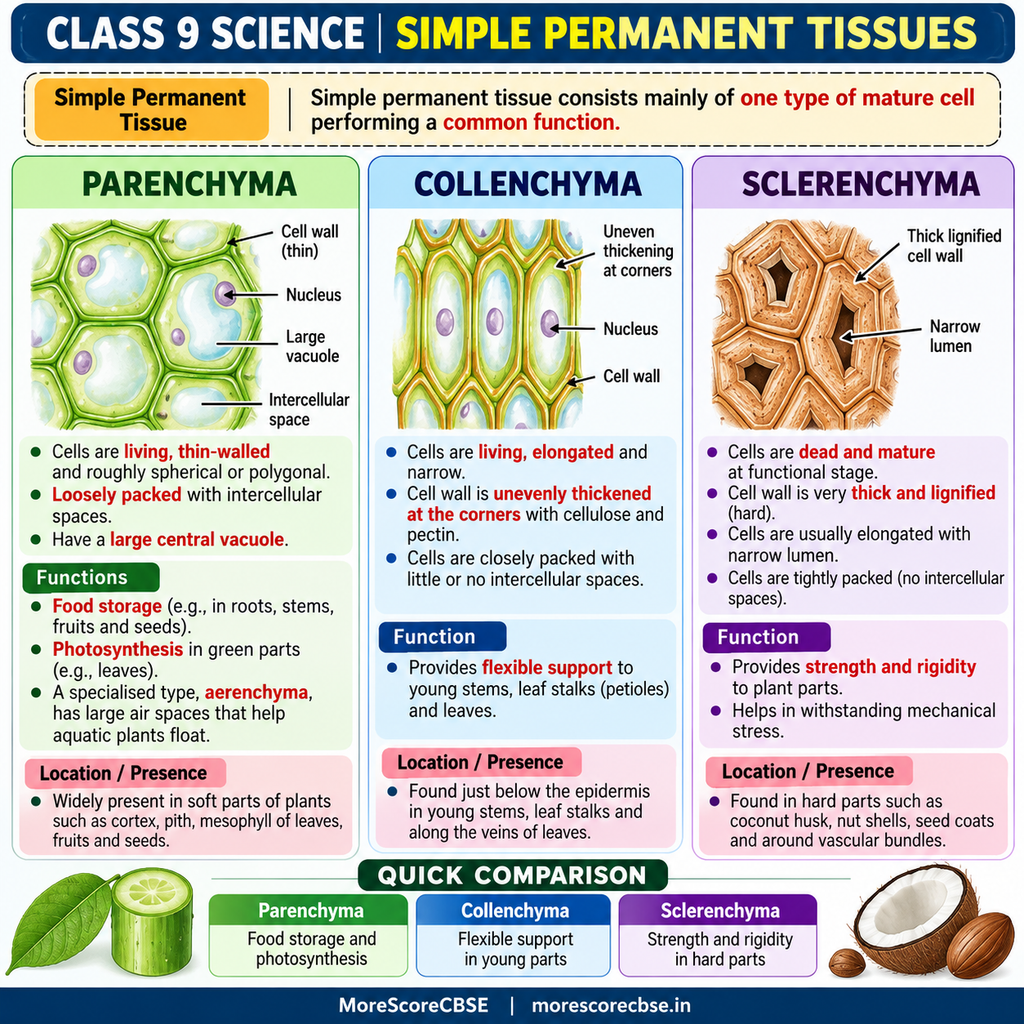
Simple Permanent Tissues
Parenchyma, collenchyma and sclerenchyma. Read the notes, then tap Show answer on each question.
Quick notes
Parenchyma: storage
Living, thin-walled cells, loosely packed with intercellular spaces. Stores food; chlorenchyma does photosynthesis; aerenchyma has air spaces for buoyancy.
Collenchyma: flexible support
Living, elongated cells with unevenly thickened corners (cellulose and pectin). Supports young stems and leaf stalks so they bend without breaking.
Sclerenchyma: strength
Usually dead at maturity, with very thick lignified walls and a narrow lumen. Found in coconut husk, nut shells and seed coats.
Comparison
| Feature | Parenchyma | Collenchyma | Sclerenchyma |
|---|---|---|---|
| Cell status | Living | Living | Usually dead |
| Cell walls | Thin | Uneven, thick at corners | Very thick, lignified |
| Intercellular spaces | Common | Little or none | Usually absent |
| Function | Storage, photosynthesis | Flexible support | Strength, rigidity |
| Example | Food-storage tissue | Young stem, petiole | Coconut husk |
Practice questions
Tap a question to reveal its answer.
1 Mark
1. What is a permanent tissue?
A plant tissue made up of cells that have differentiated and become specialised for particular functions.
2. Name the three simple permanent tissues.
Parenchyma, collenchyma and sclerenchyma.
3. Which tissue stores food in many plant parts?
Parenchyma.
4. Which tissue provides flexible support to young stems?
Collenchyma.
5. Which tissue has thick, lignified cell walls?
Sclerenchyma.
6. What is aerenchyma?
A specialised parenchyma with large air spaces that help aquatic plants stay buoyant.
7. Which substance makes sclerenchyma walls hard?
Lignin.
8. Which tissue performs photosynthesis in green parts?
Chlorenchyma, a specialised parenchyma containing chloroplasts.
9. Are collenchyma cells living or dead?
Living.
10. Give one example of a structure containing sclerenchyma.
Coconut husk.
2 Marks
1. Differentiate between parenchyma and collenchyma.
Parenchyma vs collenchyma:
1. Cell walls: parenchyma has relatively thin walls; collenchyma has unevenly thickened walls, especially at the corners (cellulose and pectin).
2. Intercellular spaces: commonly present in parenchyma; little or none in collenchyma.
3. Cell shape: parenchyma cells are often rounded, oval or polygonal; collenchyma cells are generally elongated.
4. Main function: parenchyma stores food (and photosynthesises when it has chloroplasts); collenchyma gives flexible support to growing parts.
5. Location: parenchyma is in the cortex, pith, mesophyll and fruits; collenchyma lies just below the epidermis of young stems and in leaf stalks.
Both are living tissues.
2. State two functions of parenchyma.
1. Storage of food: parenchyma cells are living and have a large central vacuole, so they store food in roots, stems, fruits and seeds (for example, the food-storing tissue of a potato).
2. Photosynthesis: parenchyma cells that contain chloroplasts, called chlorenchyma, make food by photosynthesis in green parts such as leaves.
(Other functions: aerenchyma gives buoyancy to aquatic plants, and parenchyma fills and supports soft internal tissue.)
3. Why is collenchyma suitable for supporting young stems?
Reasons:
1. Its cells are living and elongated, so they can keep up with the growth of young stems.
2. Its walls are unevenly thickened, especially at the corners, with cellulose and pectin. This gives support without making the stem stiff.
3. Cells are closely packed with little or no intercellular space, which adds strength.
Result: young stems stay upright yet can bend in the wind without breaking easily.
4. State two characteristics of sclerenchyma.
1. Thick, lignified walls: lignin makes the walls very hard and rigid, and the lumen (internal cavity) is often narrow.
2. Usually dead at maturity: the cells are closely packed and act as strong supporting material, so the tissue gives mechanical strength, rigidity and protection (for example in coconut husk fibres and hard nut shells).
5. Differentiate between simple and complex permanent tissues.
1. Cell types: simple tissues have one main type of mature cell; complex tissues have different types of cells.
2. Working: in simple tissues the cells all do a common function; in complex tissues the different cells work together for a common function.
3. Examples: simple: parenchyma, collenchyma, sclerenchyma; complex: xylem and phloem.
6. What is the function of aerenchyma?
Aerenchyma is a specialised parenchyma containing large air spaces. These spaces make aquatic plant parts lighter and increase buoyancy, so they float or stay upright in water.
3 Marks
1. Describe the structure and functions of parenchyma.
Living cells with relatively thin walls, commonly loosely packed with intercellular spaces. It stores food, performs photosynthesis in green parts (chlorenchyma) and forms aerenchyma in some aquatic plants for buoyancy.
2. Explain how collenchyma provides flexible support.
Living cells with unevenly thickened walls, especially at the corners, containing cellulose and pectin. This supports young stems, leaf stalks and growing parts while letting them bend without breaking easily.
3. Describe the structure and functions of sclerenchyma.
Cells with thick, lignified walls, usually dead at maturity with narrow lumens. The walls give strength, rigidity and protection. Examples: fibres in coconut husk, hard nut shells.
4. Differentiate between parenchyma, collenchyma and sclerenchyma.
Parenchyma: living, thin-walled, with intercellular spaces; storage.
Collenchyma: living, unevenly thickened corners; flexible support.
Sclerenchyma: thick lignified walls, usually dead; strength and rigidity.
5. Explain how structure suits function in each simple permanent tissue.
Parenchyma: thin walls and living cells suit storage and metabolism.
Collenchyma: uneven thickening gives flexible support.
Sclerenchyma: thick lignified walls give strength and rigidity.
Assertion-Reason
Options: A = both true and Reason explains Assertion. B = both true but Reason does not explain it. C = Assertion true, Reason false. D = Assertion false, Reason true.
1. Assertion: Parenchyma is suitable for food storage. Reason: Parenchyma consists of living cells that can store food materials.
Answer: A
Assertion: True. Parenchyma is the main food-storing tissue in roots, stems, fruits and seeds.
Reason: True. Its cells are living and have a large central vacuole, so they can hold stored food.
Explanation: Living cells able to store food are exactly why parenchyma suits storage, so the Reason correctly explains the Assertion.
2. Assertion: Collenchyma provides flexible support to young stems. Reason: Collenchyma cells have unevenly thickened walls, especially at the corners.
Answer: A
Assertion: True. Collenchyma supports young stems and growing parts.
Reason: True. Its walls (cellulose and pectin) are thickened unevenly, mainly at the corners.
Explanation: This uneven thickening gives support without making the part stiff, so young stems can bend without breaking. The Reason explains the Assertion.
3. Assertion: Sclerenchyma provides strength and rigidity. Reason: Sclerenchyma cells have thick, lignified walls.
Answer: A
Assertion: True. Sclerenchyma gives mechanical strength and rigidity.
Reason: True. Its walls are very thick and contain lignin.
Explanation: Lignin makes the walls hard and rigid, which is why the tissue is strong. The Reason explains the Assertion.
4. Assertion: Parenchyma cells are always dead at maturity. Reason: Parenchyma generally consists of living cells with thin walls.
Answer: D
Assertion: False. Parenchyma cells are living, not dead. (Sclerenchyma is the tissue usually dead at maturity.)
Reason: True. Parenchyma generally has living cells with relatively thin walls.
Explanation: The Assertion is wrong, but the Reason is a correct statement, so the answer is D.
5. Assertion: Collenchyma and sclerenchyma have identical cell-wall structures. Reason: Sclerenchyma has thick lignified walls, while collenchyma has unevenly thickened walls for flexibility.
Answer: D
Assertion: False. Their walls are different: collenchyma is unevenly thickened (cellulose and pectin), sclerenchyma is thick and lignified.
Reason: True. It correctly describes this difference.
Explanation: The Reason actually disproves the Assertion, so the Assertion is false and the Reason is true: D.
HOTS
1. A potato stores food in its underground stem. Which tissue is mainly associated with food storage?
Answer: Parenchyma.
Explanation: Parenchyma cells are living, thin-walled and have a large central vacuole, so they can hold stored food. The potato is a stem, and parenchyma stores food in stems, roots, fruits and seeds. Sclerenchyma is dead and cannot store food, and collenchyma mainly gives flexible support.
2. A young plant bends in the wind without breaking. Which tissue gives flexible support?
Answer: Collenchyma.
Explanation: Collenchyma lies just below the epidermis of young stems. Its living cells have unevenly thickened corners, which give support while still allowing bending. Sclerenchyma is too rigid, so it would make a young stem stiff and easier to snap.
3. A coconut has a tough, fibrous outer covering. Which tissue makes it strong?
Answer: Sclerenchyma.
Explanation: The husk contains sclerenchymatous fibres. Their thick walls contain lignin, which makes them hard and rigid, so the husk resists mechanical stress and protects the inner parts of the coconut.
4. An aquatic plant has large air spaces in some tissues. How do they help?
Answer: They provide buoyancy.
Explanation: This tissue is aerenchyma, a specialised parenchyma. The large air spaces make plant parts lighter than the water around them, so they stay afloat. The air spaces also form a space inside the plant for gases.
5. A tissue has thick walls, but the thickening is uneven and strongest at the corners. Collenchyma or sclerenchyma?
Answer: Collenchyma.
Explanation:
1. Uneven thickening, especially at the corners, is the key feature of collenchyma.
2. Collenchyma cells are living and give flexible support.
3. Sclerenchyma has very thick, lignified walls, is usually dead at maturity and gives rigidity.
So the pattern of thickening, not just thickness, identifies the tissue.
6. A student sees a hard seed covering and concludes it is entirely sclerenchyma. Is this justified?
Answer: Not fully justified.
Explanation: Sclerenchyma commonly forms hard protective structures such as some seed coats and nut shells, so the guess is reasonable. But hardness alone is not proof. To identify a tissue confidently, you must examine its cells: thick lignified walls, narrow lumen and dead cells at maturity. Also, a covering may contain other tissues as well.
7. Why does a plant need both flexible and rigid supporting tissues?
Explanation:
1. Flexible support (collenchyma) suits young, growing parts such as stems and leaf stalks, which must bend in wind without breaking.
2. Rigid support (sclerenchyma) suits parts that must be hard and strong, such as husks, shells and fibres, and resist mechanical stress.
3. Using both lets the plant stay strong and still flexible where growth and movement are needed.
Fill blanks
1. Permanent tissues develop through cell ________.
Differentiation
2. The three simple permanent tissues are parenchyma, collenchyma and ________.
Sclerenchyma
3. Parenchyma has living cells with relatively ________ walls.
Thin
4. Parenchyma mainly stores ________.
Food
5. Parenchyma with large air spaces is called ________.
Aerenchyma
6. Collenchyma has unevenly thickened walls, especially at the ________.
Corners
7. Collenchyma provides ________ support.
Flexible
8. Sclerenchyma walls contain ________.
Lignin
9. Sclerenchyma cells are usually ________ at maturity.
Dead
10. A coconut’s tough outer covering contains ________ fibres.
Sclerenchymatous