Cbse class 9 Meristematic Tissue — The Growing Tissue of Plants
Meristematic Tissue – Class 9 Science
Class 9 Science · Chapter 3: Tissues in Action
🌱 Meristematic Tissue
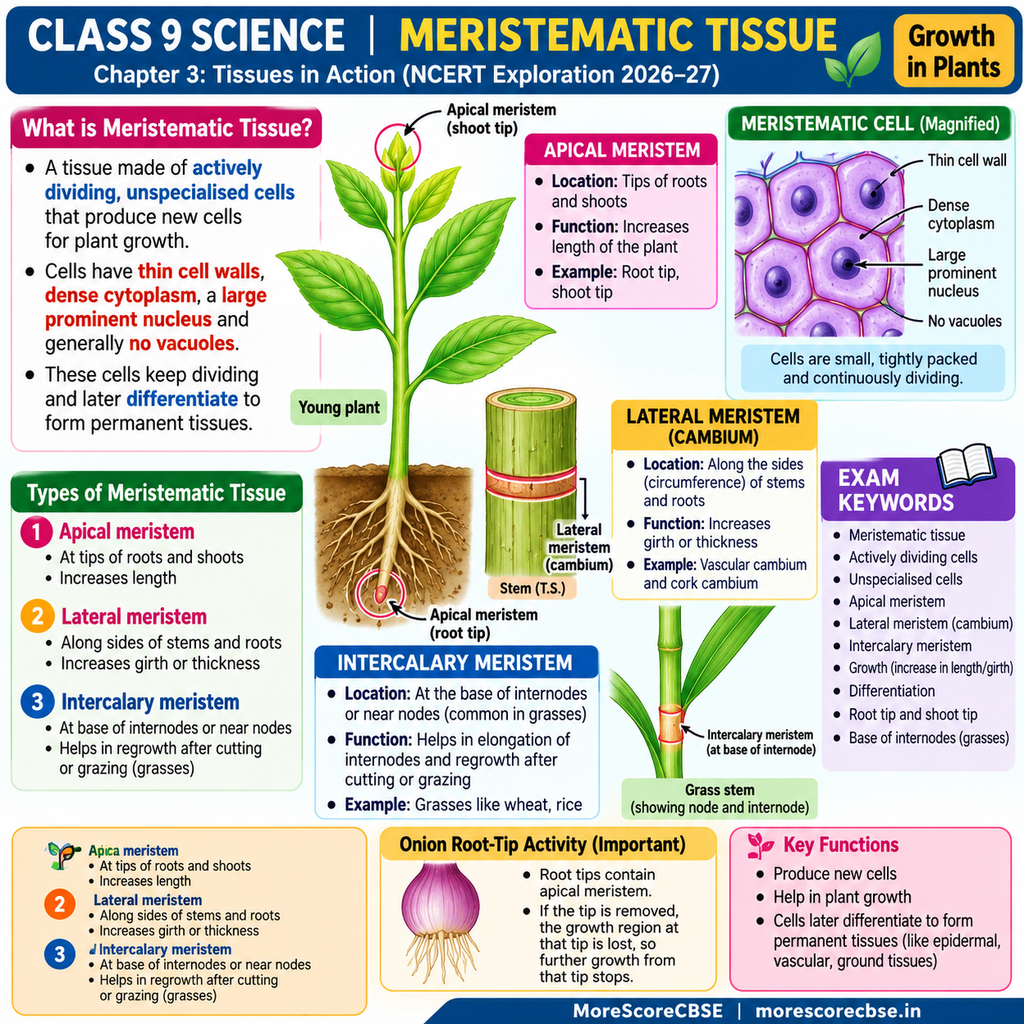
Meristematic tissue is a plant tissue made up of actively dividing cells that produce new cells and help the plant grow. These cells divide repeatedly. Some new cells remain meristematic, while others become specialised and develop into permanent tissues.
Meristem: a region containing meristematic tissue.
Growth: an increase in dimensions or biomass.
Differentiation: the process by which cells develop specialised structures and functions.
Characteristics of meristematic cells
Meristematic cells have features suited to repeated cell division.
Characteristic
Explanation
Small cells
Generally small and compact
Thin cell walls
Walls are usually thin
Dense cytoplasm
Abundant cytoplasm
Prominent nucleus
Usually large and conspicuous
Vacuoles generally absent
Large storage vacuoles are usually absent
Tightly packed
Little or no intercellular space
Active division
Produce new cells through cell division
Why are vacuoles generally absent?
Meristematic cells are specialised for active division rather than extensive storage. Large vacuoles are therefore generally absent, leaving the cells compact.
Types of meristematic tissue
There are three main types.
A. Apical meristem
Meristematic tissue at the tips of roots and shoots that helps increase the length of the plant. It produces new cells that contribute to the elongation of roots and shoots.
Location: root tips, shoot tips
Example: a young plant grows taller while its roots grow deeper into the soil.
Q. Which meristem is responsible for the increase in length of roots and shoots?Apical meristem.
B. Lateral meristem
Meristematic tissue that contributes to an increase in the girth or thickness of stems and roots. It produces new cells that increase the diameter of plant parts.
Location: along the sides of stems and roots (vascular cambium, cork cambium)
Example: a young tree trunk becomes thicker as the tree grows.
In woody plants, lateral meristems contribute to secondary growth. Annual growth rings can provide information about a tree’s age and growth conditions.
Q. Which meristem helps increase the thickness of a tree trunk?Lateral meristem.
C. Intercalary meristem
Meristematic tissue near the nodes or at the bases of internodes in certain plants, particularly grasses. It contributes to the elongation of internodes and helps some plants regrow after cutting or grazing.
Location: base of certain internodes; near nodes in suitable plants
Examples: grass growing again after mowing or grazing; hedges producing new growth after trimming
Intercalary meristems explain why many grasses continue growing even after their upper portions are cut.
Comparison
Feature
Apical
Lateral
Intercalary
Location
Root and shoot tips
Sides of stems and roots
Near nodes or base of certain internodes
Main function
Increases length
Increases girth
Supports elongation and regrowth
Type of growth
Lengthwise
Increase in thickness
Localised elongation
Example
Growing root tip
Thickening tree trunk
Grass growing after mowing
Key exam phrase
Increase in length
Increase in girth
Regrowth after cutting
Onion root-tip experiment
This experiment demonstrates the importance of apical meristem.
Aim: to investigate where root growth occurs.
Materials: two onion bulbs, two jars containing water, a ruler.
Procedure
Place one onion bulb over each jar so its roots can grow into the water.
Allow roots to grow for a few days.
Measure their lengths.
Cut off the root tips of one bulb.
Continue observing and measuring both sets of roots.
Observation: roots with intact tips continue to grow in length. Removing the root tips removes the apical growth region, so further elongation from those tips stops.
Conclusion: apical meristem at the root tip is responsible for root growth in length.
Competency-based Q. A student cuts the tips of growing roots. Why does further elongation from the cut tips stop?The apical meristem that produces new cells for root elongation has been removed.
What is differentiation?
When meristematic cells divide, some new cells remain capable of division. Others gradually develop specialised structures and functions. This process is called differentiation.
Permanent tissues perform specialised functions such as storage, support, protection and transport.
Meristematic tissue
Permanent tissue
Cells actively divide
Cells have generally differentiated
Produce new cells for growth
Perform specialised functions
Usually small and tightly packed
Structure varies with function
Large vacuoles generally absent
Vacuoles may be present, depending on the tissue
Practice questions
One mark
Q1. What is meristematic tissue?Plant tissue made up of actively dividing cells that produce new cells and support growth.
Q2. Which meristem increases the length of roots and shoots?Apical meristem.
Q3. Which meristem increases the girth of stems?Lateral meristem.
Q4. Which meristem helps grass regrow after mowing?Intercalary meristem.
Q5. Name the process by which meristematic cells become specialised.Differentiation.
Q6. Are meristematic cells generally tightly packed?Yes.
Q7. Do they usually have large storage vacuoles?No. Large vacuoles are generally absent.
Q8. Where is apical meristem found?At the tips of roots and shoots.
Q9. What does girth mean?The thickness or circumference of a plant part.
Q10. Which tissue produces new cells for plant growth?Meristematic tissue.
Two marks
Q1. State two characteristics of meristematic cells.(1) Dense cytoplasm and a prominent nucleus. (2) Actively dividing and generally tightly packed with little or no intercellular space.
Q2. Differentiate between apical and lateral meristems.Apical: at root and shoot tips; increases plant length. Lateral: along the sides of stems and roots; increases girth or thickness.
Q3. Why are meristematic cells generally small and tightly packed?They are adapted for repeated cell division. Small size and close arrangement support the organisation of actively dividing tissue.
Q4. What is differentiation?The process by which cells develop specialised structures and functions, often becoming part of permanent tissues.
Q5. Why does grass grow again after mowing?Intercalary meristem in suitable regions of the grass keeps producing new cells, enabling regrowth.
Three marks
Q1. Describe the three types of meristematic tissue and their functions.Apical: tips of roots and shoots; increases length. Lateral: sides of stems and roots; increases thickness or girth. Intercalary: near nodes or bases of certain internodes; supports elongation and regrowth after cutting in plants such as grasses.
Q2. Describe the main characteristics of meristematic cells.Generally small with thin cell walls, dense cytoplasm and a large, prominent nucleus. Tightly packed with little or no intercellular space. Large vacuoles are generally absent. These features suit repeated cell division and plant growth.
Q3. Explain the onion root-tip experiment.Two onion bulbs are placed over jars of water and root growth is observed. After a few days, the root tips of one bulb are cut while the other is left unchanged. Intact roots keep growing, whereas growth from cut tips stops. This shows that root tips contain apical meristem responsible for growth in length.
Q4. Explain how meristematic tissue gives rise to permanent tissue.Meristematic cells divide repeatedly to produce new cells. Some remain meristematic, while others undergo differentiation and develop specialised structures and functions. These cells form permanent tissues that perform storage, support, protection and transport.
1. A: Apical meristem helps increase the length of a plant. R: It occurs at the tips of roots and shoots and produces new cells.A
2. A: Lateral meristem is mainly responsible for increasing the length of roots and shoots. R: Lateral meristem contributes to an increase in girth.D
3. A: Meristematic cells generally have dense cytoplasm and a prominent nucleus. R: They are adapted for active cell division.A
4. A: Intercalary meristem helps some grasses regrow after cutting. R: It occurs near nodes or at the bases of certain internodes.A
5. A: Meristematic cells usually contain large storage vacuoles. R: They are actively dividing and generally lack large vacuoles.D
HOTS and application-based
Q1. A gardener trims a lawn and the grass grows again after a few days. Which tissue explains this?Intercalary meristem, which produces new cells near nodes or at the bases of internodes.
Q2. A tree trunk thickens each year, but its height does not increase at the same rate. Which meristem is mainly responsible?Lateral meristem, which contributes to secondary growth and an increase in girth.
Q3. A student cuts the tip of a young root and the root no longer elongates from that tip. What conclusion can be drawn?The root tip contains apical meristem, necessary for growth in length. Removing it removes the active growth region.
Q4. Cells are small, tightly packed, with dense cytoplasm and prominent nuclei, and are actively dividing. Which tissue is this?Meristematic tissue.
Q5. Some new cells keep dividing while others develop specialised functions such as transport and support. Which process explains this?Differentiation.
Fill in the blanks
#
Question
Answer
1
Plant tissue of actively dividing cells is called ______ tissue.
Meristematic
2
______ meristem occurs at the tips of roots and shoots.
Apical
3
The meristem that increases girth is ______ meristem.
Lateral
4
______ meristem helps suitable grasses regrow after mowing.
Intercalary
5
Meristematic cells have a large, prominent ______.
Nucleus
6
They generally have ______ cytoplasm.
Dense
7
The process by which cells become specialised is ______.
Differentiation
8
The thickness or circumference of a stem is its ______.
Girth
9
The growing region at a root tip contains ______ meristem.
Apical
10
Differentiated cells form specialised ______ tissues.