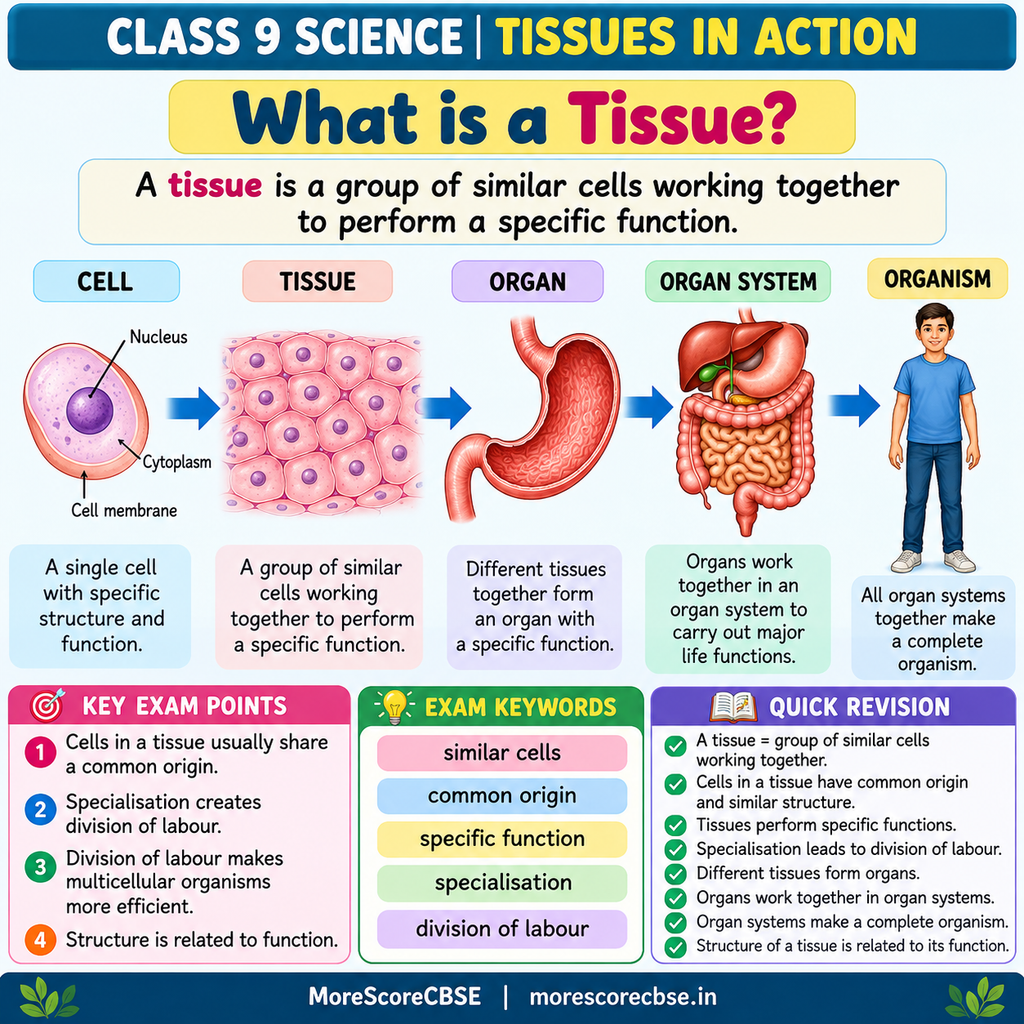
🔬 What Is a Tissue?
A tissue is a group of similar cells that work together to perform a specific function. Its cells generally share a common origin and structural features suited to that function.
1. Examples of tissues
| Tissue | Main function | Example / location |
|---|---|---|
| Epithelial | Covers and protects surfaces | Skin |
| Muscular | Produces movement | Muscles |
| Nervous | Transmits signals | Brain and nerves |
| Xylem | Transports water and minerals | Plant vascular tissue |
| Phloem | Transports prepared food | Plant vascular tissue |
2. Why do multicellular organisms need tissues?
A unicellular organism is a single cell doing every job needed for life. A multicellular organism has many cells, and different cells specialise for different tasks.
In humans
- Muscle cells help produce movement.
- Nerve cells transmit signals.
- Epithelial cells cover and line surfaces.
- Blood transports substances around the body.
In plants
- Meristematic tissues produce new cells for growth.
- Xylem transports water and minerals.
- Phloem transports prepared food.
- Protective tissues protect plant surfaces.
3. Division of labour
Division of labour is the distribution of different functions among specialised cells, tissues, organs or organ systems. Instead of every cell doing every task, different groups do specific jobs.
| Human body | Function | Plant body | Function |
|---|---|---|---|
| Muscle tissue | Movement | Meristematic tissue | Growth |
| Nervous tissue | Communication, coordination | Xylem | Water and mineral transport |
| Epithelial tissue | Covering, lining, protection | Phloem | Food transport |
| Blood | Transport of substances | Protective tissue | Protection |
Why is it important?
- Specialised functions are performed efficiently.
- Different tissues can work together.
- It supports the functioning of complex multicellular organisms.
4. Levels of organisation
- Cell: basic structural and functional unit of life (a muscle cell).
- Tissue: group of similar cells working together (muscular tissue).
- Organ: different tissues working together (the stomach).
- Organ system: organs working together for major functions (the digestive system).
- Organism: the complete living individual (a human being).
Important: different tissues form organs; different organs cooperate within organ systems.
5. Structure and function
| Tissue | Structural feature | How it helps |
|---|---|---|
| Epithelial | Cells closely packed | Covering and protection |
| Muscular | Contractile machinery in cells | Produces movement |
| Nervous | Neurons with specialised extensions | Transmits signals |
| Xylem | Specialised conducting elements | Transports water and minerals |
| Phloem | Specialised conducting cells | Transports prepared food |
Exam keyword: structural adaptation to function.
6. Tissue formation: a simple explanation
In plants, meristematic cells divide and can later become specialised permanent tissues. In animals, cells also specialise to form different tissues. Not all cells in a tissue are identical in every detail; what matters is that they cooperate in a common function and have structure suited to it.
7. Practice questions
One mark
Two marks
Three marks
Assertion–Reason
HOTS and competency-based
Fill in the blanks
| # | Question | Answer |
|---|---|---|
| 1 | A group of similar cells performing a specific function is a ______. | Tissue |
| 2 | The basic structural and functional unit of life is the ______. | Cell |
| 3 | Distributing functions among specialised structures is division of ______. | Labour |
| 4 | Different tissues work together to form an ______. | Organ |
| 5 | A group of organs working together forms an organ ______. | System |
| 6 | Muscular tissue is specialised for ______. | Contraction / movement |
| 7 | Nervous tissue helps transmit ______. | Signals |
| 8 | ______ transports water and minerals in plants. | Xylem |
| 9 | Phloem transports prepared ______ in plants. | Food |
| 10 | Cell → Tissue → Organ → Organ system → ______. | Organism |