class 7 transportation in animals and plants notes
Class 7 – Transportation in Animals and Plants
Questions covered are:
- Circulatory system
- Define blood?
- What is the role of blood?
- What are the two components of blood?
- Define plasma?
- Write the difference between RBC, WBC, and Platelets
- What are blood vessels?
- Write the difference between arteries and veins?
- Write a short note on capillaries?
- Define Pulse?
- 11.Write a Short Note on the Heart?
- .Discuss the Blood Circulation in the Human Body in Detail?
- Define Heartbeat?
- Stethoscope & Sphygmomanometer
- Excretion in Animals
- Why Do Plants Need a Transport System?
- Translocation
****************************************************************
- Circulatory system is formed by heart, blood and network of blood vessels.
- Define blood?
Blood is a red coloured fluid that flows in blood vessels to every part of body.
An average adult has 4.5 – 5.5 L of blood. - What is the role of blood?
Substances are:- Blood transports digested food from small intestine to all cells of body.
- Blood transports O₂ from lungs to body cells and CO₂ from cells to lungs.
- Blood transports waste products from body cells and helps in the removal out of body.
- What are the two components of blood?
There are two components of blood
| Component Type | Description |
| Fluid component | Blood plasma |
| Solid component | Blood cells: RBC / Erythrocytes, WBC / Leucocytes, Platelets / Thrombocytes |
- Define plasma?
Plasma is fluid part of blood. - Write the difference between RBC, WBC, and Platelets?
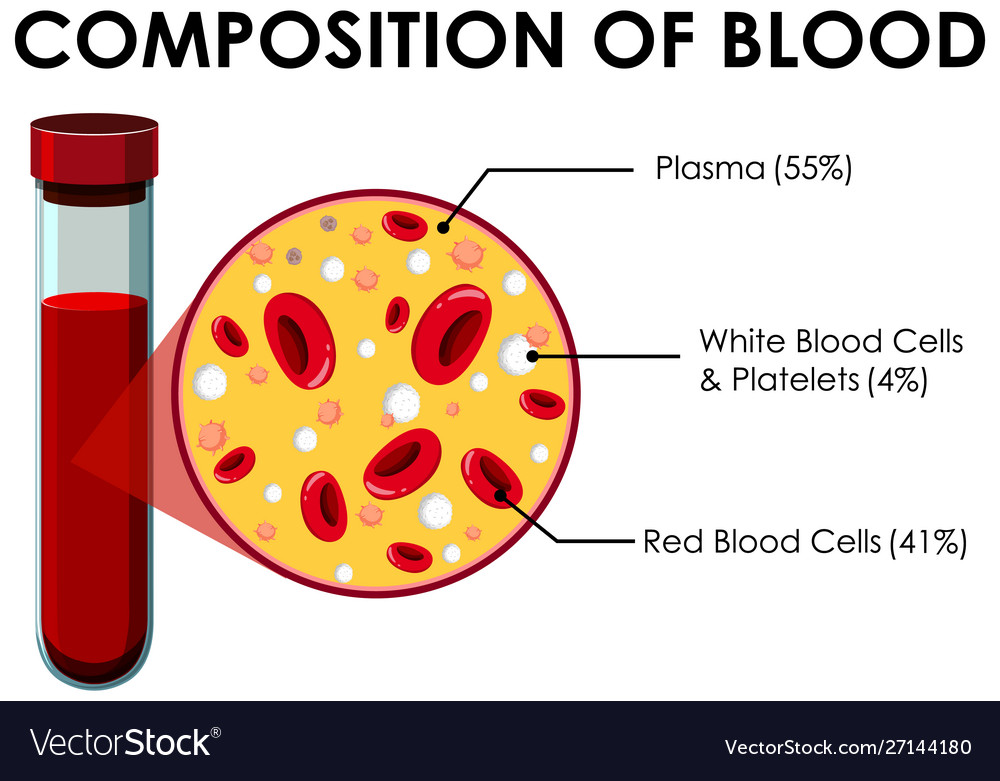
| RBC | WBC | Platelets |
| Red blood cells, also called Erythrocytes. | White blood cells, also called Leucocytes. | Platelets, also called Thrombocytes. |
| RBCs are red in colour due to the presence of haemoglobin. | WBCs are colourless. | Platelets are also colourless. |
| RBCs are disc-shaped cells but do not have a nucleus. | WBCs are irregular-shaped cells with a nucleus. | Platelets are round or small irregular-shaped cells, without a nucleus. |
| Lifespan of RBC is 120 days. | Lifespan of WBC varies from hours to years, depending on the type. | Lifespan of platelets is 8-14 days. |
| Function of RBC: Transports O₂ from lungs to all body cells and carries CO₂ from body cells to lungs. | Function of WBC: Fights against germs that cause diseases entering the body. | Function of platelets: Helps in blood clotting. |
| Number of RBCs in 1 cubic mm of blood: About 5,000,000. | Number of WBCs in 1 cubic mm of blood: 4,000 – 11,000. | Number of platelets in 1 cubic mm of blood: 1,50,000 – 4,50,000. |
7.What are blood vessels?
Blood vessels are thin tube-like structures through which blood flows.
There are three types of blood vessels: arteries, veins, and capillaries.
8.Write the difference between arteries and veins
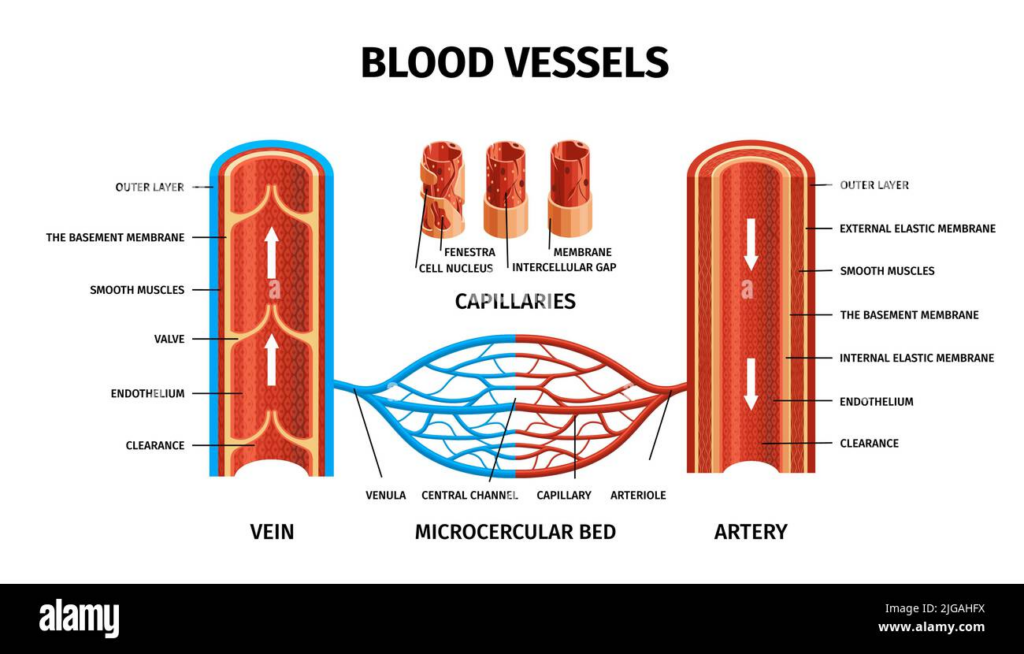
| Arteries | Veins |
| Arteries are blood vessels that carry blood from the heart to various parts of the body. | Veins are blood vessels that carry blood from all parts of the body back to the heart. |
| All arteries, except the pulmonary artery, carry oxygen-rich blood. | All veins, except the pulmonary vein, carry carbon dioxide-rich blood. |
| Arteries have thick, elastic, muscular walls for the rapid flow of blood at high pressure. | Veins have thin, less elastic, muscular walls because blood flow is not rapid at low pressure. |
| Arteries lie deep in the body; hence, they are not visible. | Veins are less deeply situated, appearing as greenish-blue lines below the skin of our hands and legs. |
| Arteries do not have any valves. | Veins have valves that allow blood to flow only in one direction, towards the heart. |
9.Write a short note on capillaries
a) Capillaries are extremely thin blood vessels that connect arteries to veins.
b) Food and O₂ present in blood pass into body cells through capillaries.
c) Carbon dioxide formed in blood cells enter the blood through thin wall of capillaries.
10.Define Pulse
A throbbing sensation due to the flow of blood under pressure in arteries is called a pulse.
The number of beats per minute is called the pulse rate.
For a normal human, it is about 72 beats per minute.
11.Write a Short Note on the Heart
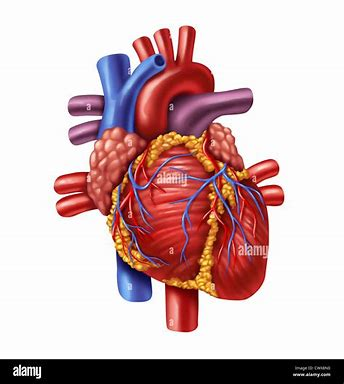
- The heart is an organ that pumps blood to all parts of the body through blood vessels.
- The heart is located between the lungs in the chest cavity, with its lower tip tilted towards the left.
- The size of an adult heart is about 12 cm in length and 9 cm in breadth.
- The heart is enclosed in a double-layered membranous sac called the pericardium.
- The heart has four chambers:
- The two upper chambers are called atria.
- The two lower chambers are called ventricles.
- The left side of the heart has oxygenated blood, whereas the right side of the heart has deoxygenated (CO₂-rich) blood.
- The left side of the heart is completely separated from the right side by a partition wall called the septum.
- This helps in preventing the mixing of oxygenated and deoxygenated blood.
- The tricuspid valve is present between the right atrium and right ventricle. It allows blood to flow from the right atrium to the right ventricle.
- The bicuspid valve is present between the left atrium and left ventricle. It allows blood to flow from the left atrium to the left ventricle.
12.Discuss the Blood Circulation in the Human Body in Detail
The circulation of blood in the human body is done by regular contractions and relaxation of the heart.
- When blood passes through capillaries of the alveoli, O₂ from the air enters the blood, making it oxygen-rich (oxygenated blood).
- Pulmonary vein brings oxygenated blood from the lungs to the left atrium. When the left atrium contracts, oxygenated blood is pushed into the left ventricle.
- When the left ventricle contracts, it pumps oxygenated blood into the main artery called the aorta.
- The aorta branches into many arteries that supply oxygenated blood to all parts of the body except the lungs.
- When oxygenated blood from arteries passes through capillaries of body organs, it delivers food and O₂ to body cells.
- At the same time, CO₂ produced during respiration enters the blood through capillaries.
- Deoxygenated blood from body organs enters the right atrium.
- When the right atrium contracts, deoxygenated blood is pushed into the right ventricle.
- When the right ventricle contracts, deoxygenated blood is pumped into the lungs through the pulmonary artery.
- In the lungs, deoxygenated blood releases CO₂ and absorbs fresh O₂ from the air being breathed in. The blood now becomes oxygenated again, and the cycle continues.
13.Define Heartbeat ?
- One complete rhythmic contraction of the heart followed by its relaxation is called a heartbeat.
- The contraction phase of the heart muscle is called systole.
- The relaxation phase of the heart muscle is called diastole.
- The average heartbeat of a person is 72-80 times per minute.
14.Stethoscope & Sphygmomanometer
- Stethoscope: A device used by doctors to hear our heartbeat. It amplifies the sound of the heartbeat and makes it audible.
- Sphygmomanometer: Used to measure blood pressure. Normal blood pressure is 120/80 mmHg.
Excretion in Animals
Define Excretion
- The process of removing waste products produced in the cells of living organisms is called excretion.
- The organs involved in excretion form the excretory system.
Excretion Processes in Various Organisms
| Organism Type | Mode of Excretion | Excretory Organ |
| Amoeba, Paramecium, Hydra | Diffusion through body surface | None (direct excretion) |
| Earthworms, Leeches | Excretion through nephridia | Nephridia |
| Cockroaches | Excretion through Malpighian tubules | Malpighian tubules |
| Vertebrates (e.g., humans, mammals, etc.) | Excretion through kidneys | Kidneys |
Main Waste Product in Various Animals
| Animal Type | Waste Product | Form of Excretion |
| Fishes | Ammonia | Dissolves directly in water |
| Birds, Reptiles | Uric Acid | Semi-solid form |
| Humans | Urea | Liquid form in urine |
Human Excretory Organs
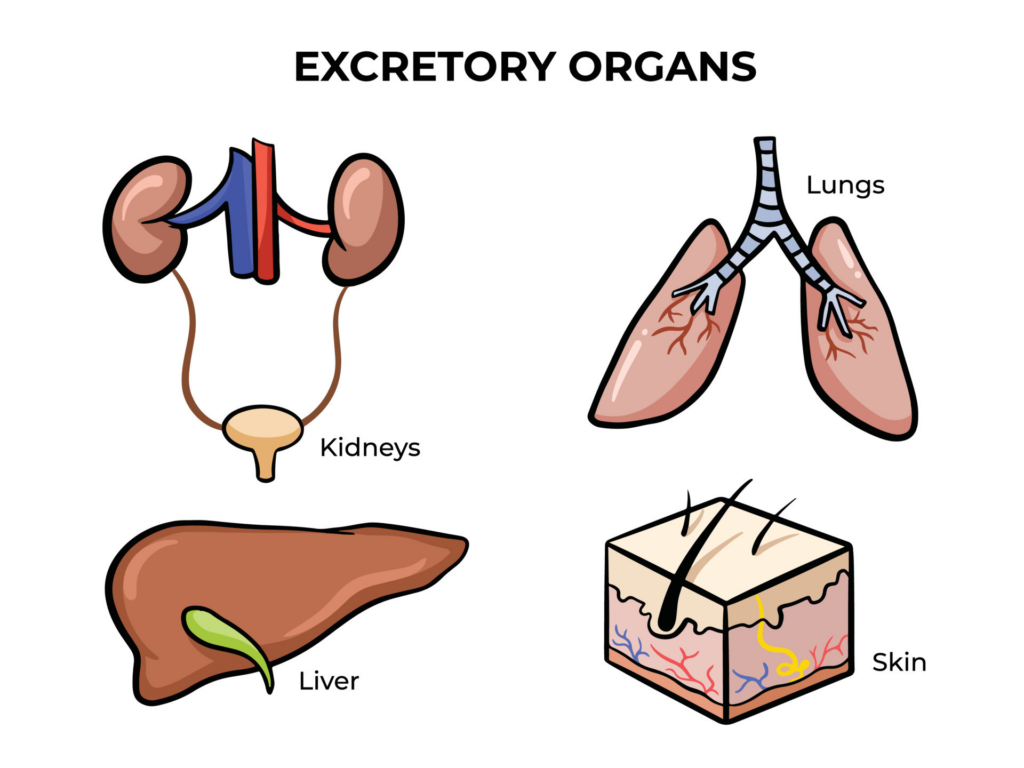
- Large intestine
- Lungs
- Skin
- Kidneys
Role of the Large Intestine in Excretion
- Undigested food is removed from the large intestine and expelled from the body through the anus in the form of feces.
How Lungs Help in Excretion?
- During the respiration process, CO₂ is produced as a waste product in body cells.
- The lungs remove CO₂ from the body during exhalation.
How Skin Helps in Excretion?
- The skin eliminates excess water, urea, salts, and other metabolic waste in the form of sweat.
Sweat and Its Functions
| Function | Description |
| Waste Removal | Removes excess water, some salts, and urea as sweat. |
| Cooling Effect | Helps in regulating body temperature, especially during summer. |
How Kidneys Help in Excretion?
- Kidneys are the main excretory organs in the human body.
- They help eliminate urea, waste salts, and excess water from the blood in the form of urine.
Organs Involved in the Human Excretory System
| Organ | Function |
| Kidneys | Filter waste from blood and produce urine. |
| Ureters | Transport urine from kidneys to the bladder. |
| Urinary Bladder | Stores urine temporarily. |
| Urethra | Carries urine out of the body. |
Where are Kidneys Located?
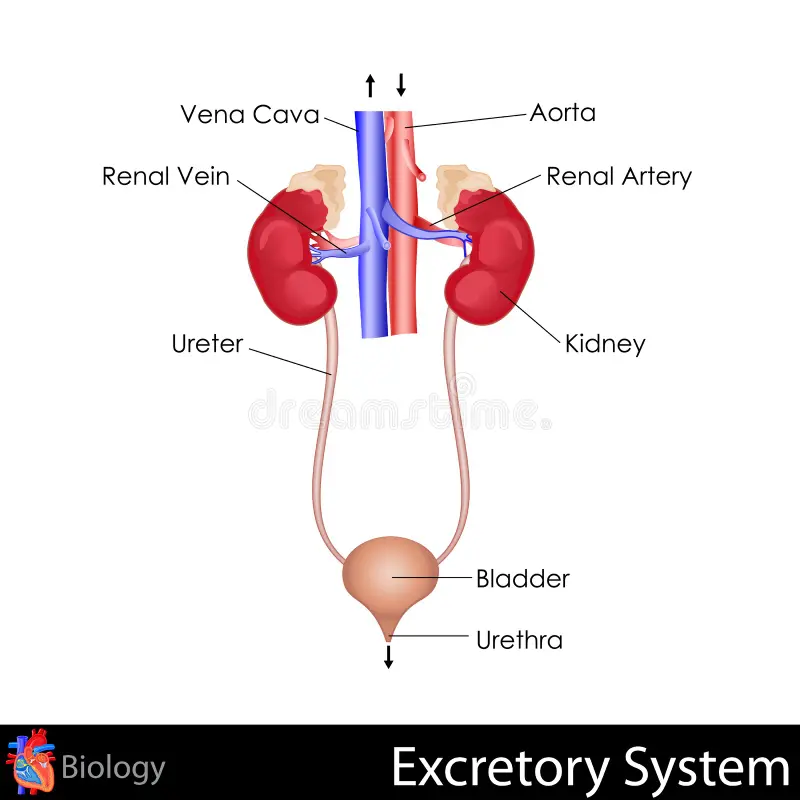
✔ Humans have a pair of kidneys.
✔ Located at the lower of the waist on either side of the vertebral column.
✔ Brick red in color.
✔ Bean-shaped structure.
Short Note on Nephrons
✔ Each kidney contains a large number of coiled tubes called nephrons.
✔ Nephrons act as filters to remove harmful substances like urea and waste salts from the blood.
Definition of Urine
- Urine is a yellowish liquid formed by the kidneys to remove waste products dissolved in water.
- An adult human passes 1–1.8 liters of urine in 24 hours.
Composition of Urine
| Component | Percentage |
| Water | 95% |
| Urea | 2.5% |
| Other waste products (uric acid, ammonia) | 2.5% |
How Urine is Removed from the Body?
✔ Urine formed in the kidneys moves to the urinary bladder through tubes called ureters.
✔ Urine is stored in the bladder and is passed out at regular intervals through the urinary opening at the end of the urethra.
Effects of Kidney Failure
✔ When kidneys stop functioning due to infection or injury, waste products accumulate in the blood.
✔ This condition can be fatal if untreated.
Usual Treatments for Kidney Failure
| Treatment | Description |
| Dialysis | A machine filters waste from the blood when kidneys fail. |
| Kidney Transplant | A damaged kidney is replaced with a healthy one from a donor. |
Here is the improved version of your content with tables and structured formatting for better clarity:
Definition of Dialysis
✔ Dialysis is the process of cleaning the blood by removing toxic waste products using a dialysis machine.
Steps in Dialysis Process
| Step | Description |
| 1 | Blood from artery in the patient’s arm is passed into the dialysis machine. |
| 2 | Waste products are removed from the blood. |
| 3 | Dialysis is continued until all blood is purified. |
| 4 | The clean blood is pumped back into the vein of the patient’s arm. |
| 5 | This process has to be done regularly. |
Kidney Transplant
✔ A kidney transplant is the process of replacing a damaged kidney with a healthy kidney from another person through a surgical procedure.
Why Do Plants Need a Transport System?
✔ Plants require a transport system to:
1️.Transport water and minerals absorbed by roots to the leaves.
2️Transport food prepared by leaves to all parts of the plant.
3️The plant transport system is called the vascular system.
4️The vascular system consists of xylem and phloem.
5️Xylem and phloem are present in all parts of the plant, such as roots, stems, branches, and leaves.
Components of the Vascular System
| Component | Function |
| Xylem | Transports water and minerals from roots to different parts of the plant. |
| Phloem | Transports food from leaves to all parts of the plant. |
How Root Hairs Help in Absorption?
✔ Water and minerals dissolved in soil are absorbed by root hairs.
✔ These move from one cell to another through a process called osmosis.
Osmosis
✔ Osmosis is the movement of water molecules across a semi-permeable membrane from a higher concentration region to a lower concentration region.
Semi-Permeable Membrane
✔ A semi-permeable membrane is a membrane that allows certain molecules or ions to pass through it by diffusion.
Ascent of Sap
✔ The evaporation of water from leaves produces a suction pull, which pulls water from roots to great heights in tall trees.
✔ The upward movement of water and minerals in a plant through xylem is called ascent of sap.
Transpiration & Its Importance
✔ In plants, water evaporates through the stomata on the surface of leaves by the process of transpiration.
| Importance of Transpiration | Description |
| 1. Helps in upward movement of water & minerals | Generates suction pull to move water and minerals from roots to leaves. |
| 2. Increases absorption rate | When transpiration is high, plants absorb more water. |
| 3. Produces cooling effect | Protects delicate plant cells from heat and sunlight. |
Translocation
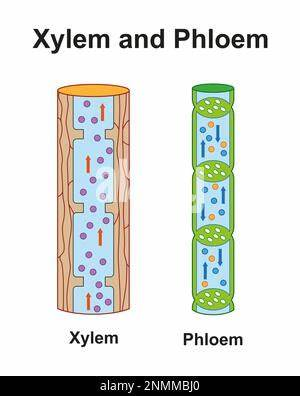
✔ Definition: The transport of food from leaves to other parts of the plant is called translocation.
✔ Translocation takes place with the help of phloem.
Phloem & Translocation of Food
✔ Phloem contains specialized cells called sieve tubes, which are arranged one above another, forming a continuous passage for food transport.
✔ Through phloem, the prepared food is transported from leaves to various parts of the plant, including:
- Stem
- Roots
- Fruits
- Seeds
- Flowers
TransportationInPlants #TransportationInAnimals #Class7Science #FreePDFDownload #PlantTransportSystem #AnimalTransportSystem
Book back questions with answers
1. Match the following:
| Column I | Column II |
|---|---|
| (i) Stomata | (b) Transpiration |
| (ii) Xylem | (d) Transport of water |
| (iii) Root hairs | (a) Absorption of water |
| (iv) Phloem | (c) Transport of food |
2. Fill in the blanks:
(i) The blood from the heart is transported to all parts of the body by the arteries.
(ii) Haemoglobin is present in red blood cells.
(iii) Arteries and veins are joined by a network of capillaries.
(iv) The rhythmic expansion and contraction of the heart is called heartbeat.
(v) The main excretory product in human beings is urea.
(vi) Sweat contains water and salts.
(vii) Kidneys eliminate the waste materials in the liquid form called urine.
(viii) Water reaches great heights in the trees because of suction pull caused by transpiration.
3. Choose the correct option:
(a) In plants, water is transported through
✅ (i) xylem
(b) Water absorption through roots can be increased by keeping the plants
✅ (iii) under the fan
4. Why is transport of materials necessary in a plant or in an animal?
Transport of materials is essential for the following reasons:
- In Plants:
- Plants need water, minerals, and food to be transported to different parts for growth, photosynthesis, and energy production.
- The xylem transports water and minerals from the roots to the leaves, while the phloem carries food from the leaves to other parts.
- In Animals:
- Animals require oxygen, nutrients, and hormones to reach every cell for energy production and growth.
- The circulatory system helps deliver these materials, while waste products are transported to excretory organs for elimination.
5. What will happen if there are no platelets in the blood?
If there are no platelets in the blood:
- Blood clotting will not occur properly, which means even a small injury could lead to excessive bleeding.
- Platelets are essential for forming clots that prevent excessive blood loss when blood vessels are damaged.
- Without platelets, internal bleeding may occur, posing a severe risk to life.
6. What are stomata? Give two functions of stomata.
Stomata are small pores present on the surface of leaves, mainly on the underside. They are surrounded by guard cells that control their opening and closing.
Functions of stomata:
- Gaseous Exchange: Stomata allow the exchange of gases like oxygen and carbon dioxide during photosynthesis and respiration.
- Transpiration: Stomata help in the loss of excess water from the plant in the form of water vapor, which creates a suction force that pulls water upward through the plant.
7. Does transpiration serve any useful function in the plants? Explain.
Yes, transpiration is highly beneficial to plants. Its key functions include:
- Cooling Effect: Transpiration cools the plant by releasing water vapor, especially during hot conditions.
- Water and Mineral Transport: Transpiration creates a suction pull that helps draw water and minerals from the roots to the leaves.
- Maintaining Water Balance: By controlling water loss, transpiration maintains the plant’s internal water balance.
8. What are the components of blood?
Blood is composed of the following key components:
- Plasma: The liquid part of blood that carries nutrients, hormones, and waste products.
- Red Blood Cells (RBCs): They contain haemoglobin, which carries oxygen to different parts of the body.
- White Blood Cells (WBCs): These cells help fight infections and protect the body from diseases.
- Platelets: Tiny cell fragments responsible for blood clotting.
9. Why is blood needed by all the parts of a body?
Blood is essential for the body because:
- It transports oxygen from the lungs to every cell for energy production.
- It delivers nutrients absorbed from food to various body parts for growth and repair.
- It carries waste products to the kidneys and lungs for excretion.
- Blood also helps maintain body temperature and fights infections through white blood cells.
10. What makes the blood look red?
Blood appears red due to the presence of haemoglobin in red blood cells. Haemoglobin is a red-colored pigment that binds with oxygen to form oxyhaemoglobin, giving blood its bright red color.
11. Describe the function of the heart.
The heart is a muscular organ that pumps blood throughout the body. Its functions include:
- The right side of the heart receives deoxygenated blood from the body and pumps it to the lungs for oxygenation.
- The left side of the heart receives oxygenated blood from the lungs and pumps it to all parts of the body.
- The heart ensures continuous circulation, supplying oxygen, nutrients, and hormones to every cell while removing waste materials.
12. Why is it necessary to excrete waste products?
Excretion is necessary to:
- Remove toxic waste products like urea, carbon dioxide, and excess salts that are produced during metabolic processes.
- Prevent the buildup of harmful substances that can damage organs and tissues.
- Maintain the body’s water balance and ensure a stable internal environment.
The kidneys, lungs, and skin play vital roles in removing these waste products efficiently.
Useful links:
