class 10 light chapter – lenses
CBSE Class 10 Science – Light Notes PDF (Free Download)
Light – Reflection and Refraction is a scoring chapter in CBSE Class 10 Science. It covers essential Physics concepts like how light travels, bends, and forms images through mirrors and lenses. To make revision easier, we have prepared colourful handwritten notes that are concise, exam-focused, and follow the NCERT syllabus.
These notes are available as a free PDF download so you can study anytime, anywhere
Introduction to Lenses
A lens is an optical device with two refracting surfaces, used to focus or disperse light rays. Lenses are widely used in instruments such as microscopes, cameras, spectacles, and telescopes to observe small, distant, or microscopic objects.
Types of Lenses
- Convex Lens (Converging Lens): Bulges outward; converges rays coming in parallel to the principal axis.
- Concave Lens (Diverging Lens): Curves inward; diverges rays coming in parallel to the principal axis.
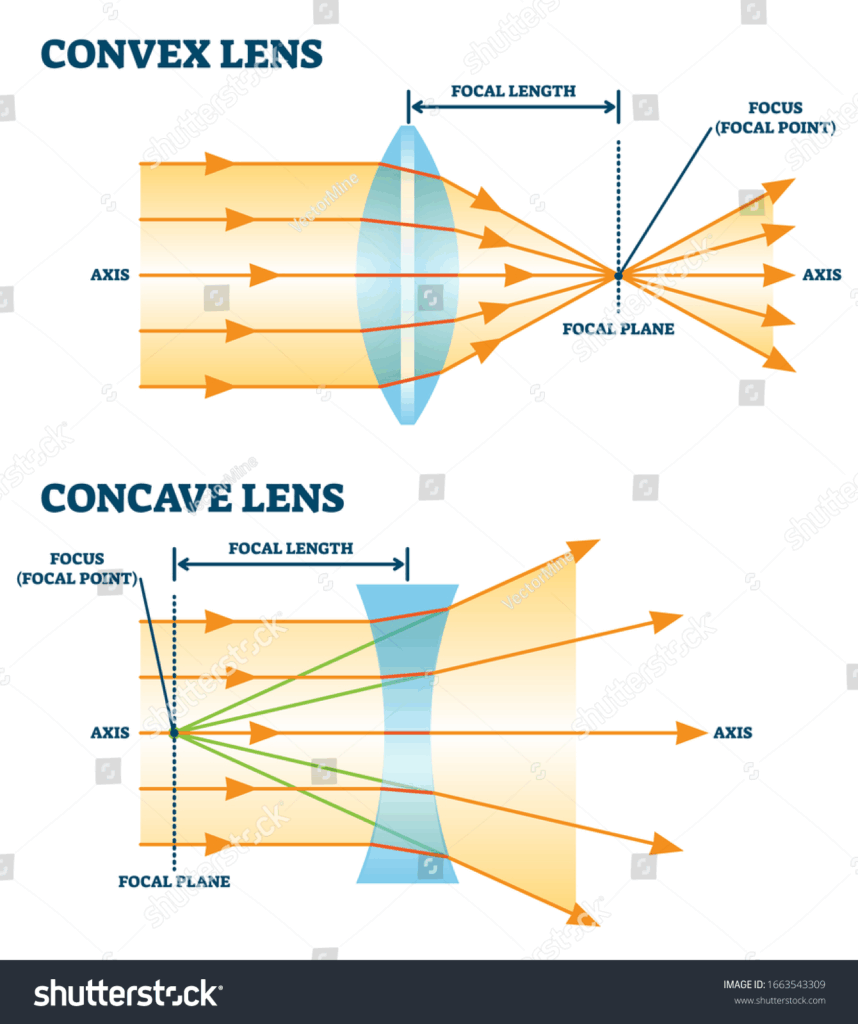
Difference between convex lens and concave lens

Important Terms
- Principal Axis: The straight line passing through the centers of curvature of the lens surfaces.
- Optical Center: The central point of the lens.
- Focus (F): Point where rays parallel to the principal axis converge (convex) or appear to diverge from (concave).
- Focal Length (f): The distance between the optical center and the focus.
- Power of a Lens (P):
Image Formation by Lenses
Convex Lens Ray Diagrams:
- Object at infinity: Image at focus, real, inverted, highly diminished.
- Object beyond 2F: Image between F and 2F, real, inverted, diminished.
- Object at 2F: Image at 2F, real, inverted, same size.
- Object between F and 2F: Image beyond 2F, real, inverted, magnified.
- Object at F: Image at infinity.
- Object between F and optical center: Image on the same side, virtual, erect, magnified.
Concave Lens Ray Diagrams:
- Object at infinity or anywhere: Image between focus and optical center, always virtual, erect, and diminished.
Uses of Lenses
- Used in microscopes, telescopes, and cameras
- Corrects vision (spectacles for myopia/hypermetropia)
- Magnifies images in laboratory equipment
Power of a Lens
- Measures the convergence or divergence ability; given by the reciprocal of focal length in meters.
- The unit is Dioptre (D).
Important Laws and Concepts
- Refraction of Light: The bending of rays passing through a lens due to change in speed as it passes from one medium to another.
- Dispersion: Splitting of white light into seven colors when passed through a prism.
- Angle of Deviation: The angle between the incident and emergent ray after passing through a prism.
- Magnification: Ratio of image height to object height.
