class 10 Human Eye and the colourful world
Image Formation in the Human Eye
The human eye is a natural optical instrument that enables us to see objects. It works on the principle of refraction of light and forms an image on the retina, which is then interpreted by the brain.
Structure of the Human Eye
- Cornea: Transparent front part of the eye that allows light to enter and causes initial refraction.
- Iris: Coloured part of the eye that controls the size of the pupil.
- Pupil: Small opening through which light enters the eye.
- Eye Lens: A transparent, elastic, convex lens that focuses light on the retina.
- Ciliary Muscles: Control the curvature (focal length) of the eye lens.
- Retina: Light-sensitive screen containing rod and cone cells.
- Optic Nerve: Carries visual information from the retina to the brain.
Steps Involved in Image Formation
1. Entry of Light Through the Cornea
Light rays reflected from an object first enter the eye through the cornea.
The cornea provides most of the refraction needed to bend the light rays toward the retina.
2. Passage of Light Through the Pupil
After passing through the cornea, light enters the eye through the pupil.
The iris controls the size of the pupil:
In bright light → pupil becomes small
In dim light → pupil becomes large
This helps regulate the amount of light entering the eye.
3. Refraction by the Eye Lens
The light rays then pass through the convex eye lens.
The lens further refracts the light and focuses it precisely on the retina.
The ciliary muscles adjust the curvature of the lens to see near and distant objects clearly.
This ability is called accommodation.
4. Formation of Image on the Retina
A real, inverted, and diminished image of the object is formed on the retina.
The retina acts like a screen where the image is formed.
5. Conversion of Light into Electrical Signals
The retina contains two types of photoreceptor cells:
Rod cells: Work in dim light and help in night vision
Cone cells: Work in bright light and help in colour vision
These cells convert the light image into electrical impulse
6. Transmission of Signals to the Brain
The electrical impulses generated in the retina are sent to the brain through the optic nerve.
7. Interpretation by the Brain
The brain interprets these signals and makes the image appear upright and meaningful, even though the image formed on the retina is inverted.
Important Characteristics of Image Formed
- Image is real
- Image is inverted
- Image is diminished
- Brain makes the image appear erect
Power of Accommodation of Human Eye
The human eye is a wonderful optical instrument which enables us to see objects of different sizes and at different distances. To see clearly, the image of an object must be formed on the retina. For this purpose, the eye must adjust the focal length of its lens according to the distance of the object. This ability of the eye is called power of accommodation.
Power of accommodation is the ability of the human eye to change the focal length of its eye lens so that it can form a clear image of objects lying at different distances on the retina.
Principle behind Power of Accommodation
The power of accommodation works on the principle that:
The curvature of the eye lens can be changed by the action of ciliary muscles.
By changing the curvature:
- Focal length changes.
- Hence the eye can focus light from near and distant objects.
Role of Ciliary Muscles
Ciliary muscles are ring-shaped muscles attached to the eye lens.
They control the shape of the lens:
(a) For distant objects
- Ciliary muscles relax.
- Eye lens becomes thin.
- Focal length increases.
- Image forms clearly on retina.
(b) For near objects
- Ciliary muscles contract.
- Eye lens becomes thick.
- Focal length decreases.
- Image again forms on retina.
Thus, the eye adjusts automatically without us realizing it.
Near Point and Far Point
Near Point
The nearest point at which an object can be seen clearly without strain is called the near point.
For a normal human eye:
Near point = 25 cm
Far Point
The farthest point at which an object can be seen clearly is called the far point.
For a normal human eye:
Far point = Infinity (∞)
Range of Vision of Normal Eye
A normal eye can see objects clearly between:
25 cm to infinity
This entire range is called the range of vision of the human eye.
Maximum Power of Accommodation
The maximum change in the power of the eye lens is known as maximum power of accommodation.
For a normal young person:
It is approximately 4 dioptres (D).
As age increases, this value decreases.
Importance of Power of Accommodation
Power of accommodation helps us in:
- Reading books and newspapers.
- Writing and doing close work.
- Watching blackboard in class.
- Driving vehicles and seeing distant objects.
Without power of accommodation, our vision would be fixed at only one distance.
Human Eye defects and their correction:
Myopia, Hypermetropia and Presbyopia are common defects of vision. In Myopia, a person can see near objects clearly but not distant ones because the image forms in front of the retina and it is corrected using a concave lens. In Hypermetropia, a person can see distant objects clearly but not near ones because the image forms behind the retina and it is corrected using a convex lens. Presbyopia is an old age defect caused due to weakening of ciliary muscles and loss of accommodation, and it is corrected using convex or bifocal lenses.
| Myopia (Short-sightedness) | Hypermetropia (Long-sightedness) | Presbyopia (Old age defect) |
|---|---|---|
| Person can see near objects clearly but not distant objects | Person can see distant objects clearly but not near objects | Person cannot see near objects clearly due to ageing |
| Near objects appear clear | Distant objects appear clear | Distant objects may appear clear |
| Distant objects appear blurred | Near objects appear blurred | Near objects appear blurred |
| Caused due to excessive curvature of eye lens or elongated eyeball | Caused due to insufficient curvature of eye lens or short eyeball | Caused due to weakening of ciliary muscles and loss of lens elasticity |
| Image is formed in front of the retina | Image is formed behind the retina | Image is formed behind the retina for near objects |
| Near point shifts closer than normal | Near point shifts beyond 25 cm | Near point shifts much beyond 25 cm |
| Far point becomes finite | Far point remains infinity | Far point usually remains infinity |
| Occurs in children and young people | Occurs due to eye strain or heredity | Occurs in old age |
| Power of eye lens increases | Power of eye lens decreases | Power of accommodation decreases |
| Corrected using concave lens (−) | Corrected using convex lens (+) | Corrected using convex or bifocal lens |
| Concave lens diverges rays before entering eye | Convex lens converges rays before entering eye | Convex part helps near vision |
| No problem in reading books | Difficulty in reading books | Difficulty in reading small letters |
| Common name: short-sightedness | Common name: long-sightedness | Common name: old age defect |
Refraction of Light Through a Prism
What is a Prism?
A prism is a transparent optical object made of glass having:
- Two triangular ends
- Three rectangular faces
The two slant faces are called refracting surfaces.
What is Refraction?
Refraction of light is the bending of light when it passes from one medium to another.
This happens because the speed of light changes in different media.
Refraction of Light Through a Prism
When a ray of light passes through a prism, it bends twice:
- At first surface (air → glass)
- At second surface (glass → air)
This is called double refraction.
Ray Path Through a Prism
When a light ray enters a prism:
• It bends towards the normal at first surface.
• Travels inside prism.
• Bends away from the normal at second surface.
• Emerges in a deviated direction.
The emergent ray is not parallel to the incident ray.
Important Terms
| Term | Meaning |
|---|---|
| Angle of incidence (i) | Angle between incident ray and normal |
| Angle of refraction (r) | Angle between refracted ray and normal |
| Angle of emergence (e) | Angle between emergent ray and normal |
| Angle of prism (A) | Angle between two refracting faces |
| Angle of deviation (D) | Angle between incident ray and emergent ray |
Angle of Deviation
The angle between the incident ray and the emergent ray is called the angle of deviation.
It shows how much the ray has turned from its original path.
Why Does Deviation Occur in Prism?
Deviation occurs because:
- Light enters at an inclined surface
- Speed of light decreases in glass
- Refraction happens twice
Factors Affecting Angle of Deviation
Angle of deviation depends on:
- Angle of incidence
- Material of prism
- Colour (wavelength) of light
- Angle of prism
Dispersion of Light Through Prism
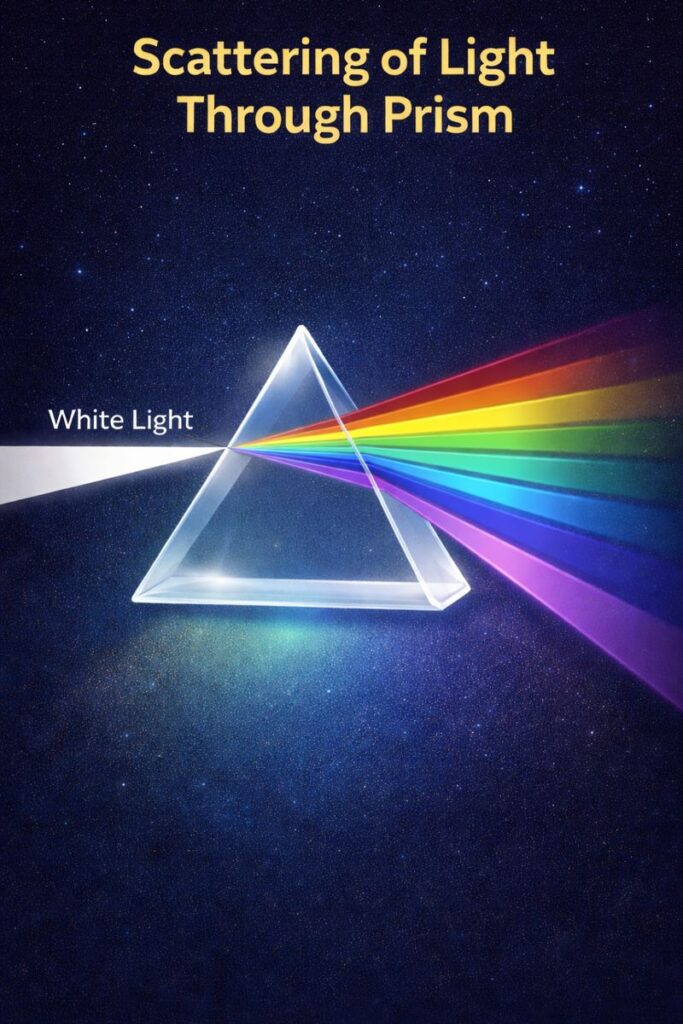
When white light passes through a prism, it splits into seven colours.
This is called dispersion of light.
The band of colours is called spectrum.
Order of Colours (VIBGYOR)
Violet
Indigo
Blue
Green
Yellow
Orange
Red
Violet bends most
Red bends least
Why Do Colours Separate?
Different colours have:
- Different wavelengths
- Different speeds in glass
So they bend by different amounts.
Formula
D = i + e − A
Where:
D = angle of deviation
i = angle of incidence
e = angle of emergence
A = angle of prism
Applications of Prism
Prism is used in:
- Spectrometer
- Binoculars
- Periscope
- Kaleidoscope
- Scientific instruments
How is a Rainbow Formed?

- Sunlight is white light Sunlight looks white, but it is actually made up of seven colours (VIBGYOR).
- Sunlight enters a raindrop When the Sun shines after rain, sunlight enters tiny water droplets in the air. Refraction and dispersion occur
- As sunlight enters the raindrop, it bends (refraction) and splits into seven colours.
- This splitting of white light is called dispersion. Internal reflection inside the raindrop
- The coloured light reflects from the inner surface of the raindrop.
- Refraction again while coming out When the light comes out of the raindrop, it bends again, making the colours more visible.
- Colours reach our eyes Different colours come out at different angles, forming a circular arc in the sky called a rainbow.
Atmospheric Refraction
- Atmospheric refraction is the bending of light as it passes through different layers of the Earth’s atmosphere.
- The Earth’s atmosphere consists of several layers of air with different densities.
- As light travels through these layers, its speed changes continuously, causing the light to bend gradually.
- The refractive index of air increases closer to the Earth’s surface because air becomes denser near the ground.
- Due to this continuous change in refractive index, light does not travel in a straight line but follows a curved path.
Effects of Atmospheric Refraction
1. Twinkling of Stars
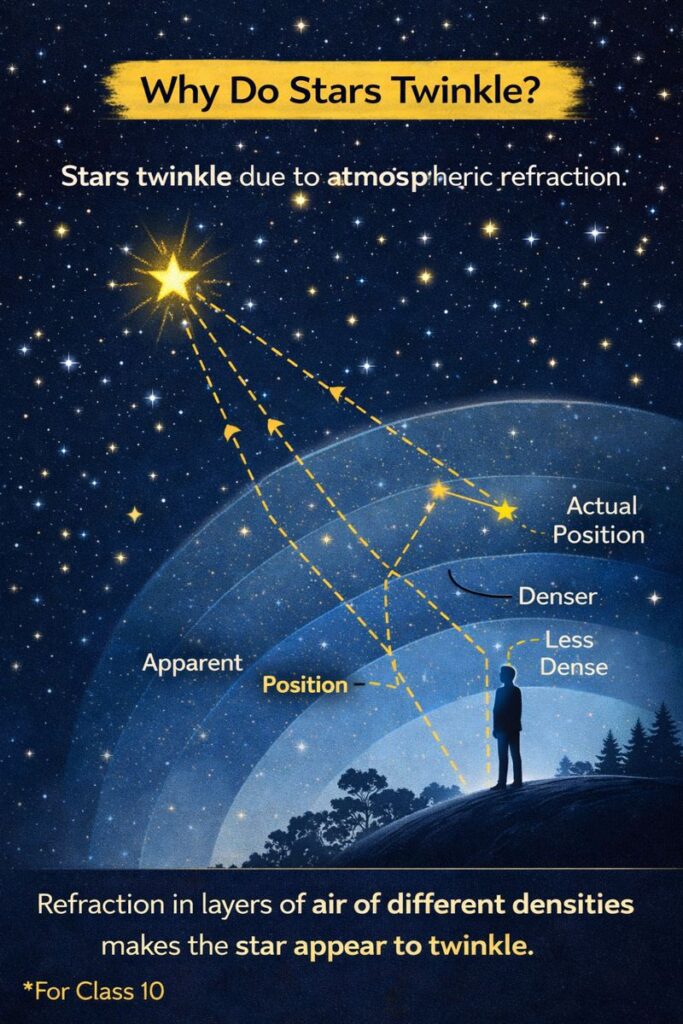
- Stars twinkle due to atmospheric refraction.
- Stars are very far away from the Earth and appear as point sources of light. When light from a star enters the Earth’s atmosphere, it passes through layers of air of different densities. Due to continuous refraction, the path of light keeps changing.
- As a result, the apparent position and brightness of the star keep changing, making the star appear to twinkle.
2. Advance Sunrise and Delayed Sunset
- Advanced Sunrise and Delayed Sunset
- Advanced sunrise means the Sun is seen earlier than the actual time, and delayed sunset means the Sun is seen even after it has actually set.
- This phenomenon occurs due to atmospheric refraction.
- The Earth’s atmosphere consists of layers of air with different densities. Light coming from the Sun passes through these layers. Due to refraction of light, the Sun’s rays bend towards the normal. Because of this bending, the Sun appears to be higher in the sky than its actual position.
- As a result, the Sun is seen about 2 minutes before actual sunrise and about 2 minutes after actual sunset. Therefore, the length of the day increases by about 4 minutes.
3. Apparent Position of Stars
- Due to refraction, stars appear slightly higher than their actual position in the sky.
- The apparent position of a star is the position at which the star appears to be seen from the Earth, which may be different from its actual position.
- This change in position occurs due to atmospheric refraction. When light from a star enters the Earth’s atmosphere, it passes through layers of air of different densities. Due to continuous refraction, the light bends towards the normal.
- Because of this bending, the star appears to be slightly higher in the sky than its actual position. This is why we do not see stars in their true positions.
Why Planets do not Twinkle?
Planets do not twinkle because they are much closer to the Earth and appear as extended sources of light (they have a disc-like shape).
When light from planets passes through the Earth’s atmosphere, the rays from different points of the planet get refracted differently. These effects cancel each other, so the brightness remains steady.
Therefore, unlike stars (which appear as point sources), planets do not twinkle and shine with a constant light.
Scattering of White Light
Scattering of light is the phenomenon in which light changes its direction when it strikes very small particles of a medium such as air, dust, or smoke.
Scattering and Wavelength
- Scattering of light depends on its wavelength.
- It is inversely proportional to the fourth power of wavelength:
- Shorter wavelength light scatters more.
- Longer wavelength light scatters less.
Scattering of White Light
- White light contains colours of different wavelengths.
- Blue light, having a shorter wavelength, is scattered the most.
- Red light, having a longer wavelength, is scattered the least.
Examples of Scattering of White Light
- Blue colour of the sky
- Red appearance of the Sun at sunrise and sunset
- Tyndall effect
Tyndall Effect
The Tyndall effect is the phenomenon in which light is scattered by colloidal particles, making the path of the light beam visible.
This happens because colloidal particles are large enough to scatter light but small enough to remain suspended in the medium.
Due to this scattering, the path of light becomes visible.
Examples of the Tyndall effect include:
- Sunlight passing through a dusty room
- Beam of light in a cinema hall
- Sunlight passing through fog or smoke
The Tyndall effect helps to distinguish between a true solution and a colloidal solution, as true solutions do not show this effect.
Why Does the Sky Appear Blue?
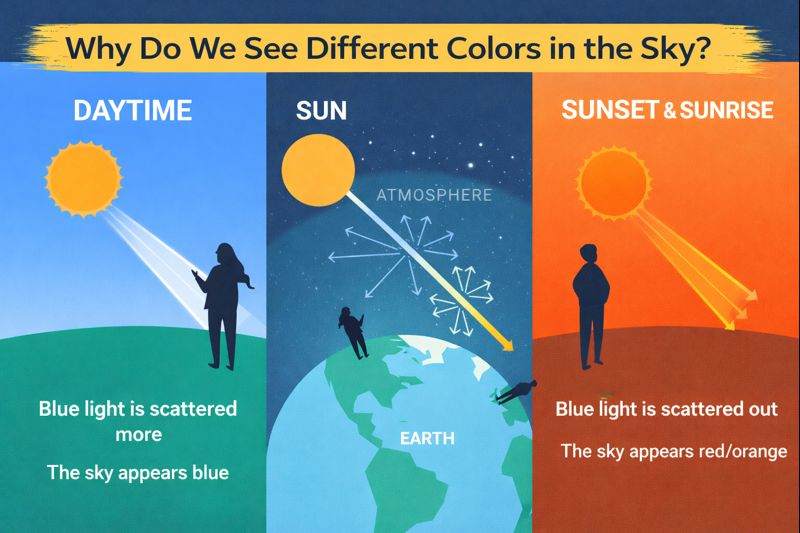
Reason: Scattering of Light
- Sunlight is made up of different colours with different wavelengths.
- The Earth’s atmosphere contains very fine particles.
- When sunlight enters the atmosphere, these particles scatter light.
- Scattering is inversely proportional to the fourth power of wavelength
- Blue light has a shorter wavelength than red light.
- Hence, blue light is scattered the most in all directions.
- When we look at the sky, this scattered blue light enters our eyes.
Why Does the Sky Look Red During Sunrise and Before Sunset?
Reason: Longer Path of Sunlight
- At sunrise and sunset, the Sun is near the horizon.
- Sunlight has to travel a longer distance through the atmosphere to reach our eyes.
- During this long path:
- Most of the blue light is scattered away by air particles.
- Light of longer wavelengths such as red and orange scatters the least.
- These longer wavelength colours reach our eyes.
