Class 10: Our Environment (Bio Notes)
Define Ecosystem?
- An ecosystem refers to a biological environment where living organisms (plants,
animals, microorganisms) interact with each other and their physical surroundings
(soil, water, air, and other non-living components). - It can be large or small, ranging from a forest to a pond or even a small patch of soil.
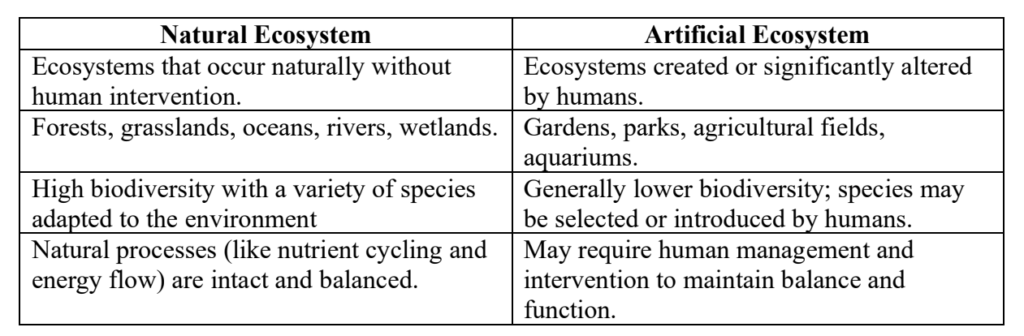
Difference between Natural and Artificial Ecosystem:
Food Chain:
- A food chain is a linear sequence that represents how energy and nutrients flow
through an ecosystem, starting from producers to various levels of consumers. - It illustrates who eats whom in a particular environment, showcasing the transfer of energy
Examples of Food Chains:
- Simple food chain operating in a grass land or forest
Grass(Producer) → Deer(Herbivore) → Lion(Carnivore) - In this food chain, grass represent the producers (first tropic level).
- Grass synthesize their own food by the process of photosynthesis.
- Grass is eaten up by deer, which represents the herbivores or the primary consumers.
- Deer in turn is consumed by lion, the carnivores or the secondary consumers.
A food chain in grassland which has four steps is :
Grass(Producers) → Insect(Herbivores) → Frog(Carnivores) → Eagle(Secondary
Carnivore)energy from one organism to another.
Importance of Food Chain:
- Energy Transfer: Food chains illustrate how energy is transferred through different levels
of the ecosystem, highlighting the dependency of organisms on one another for survival. - Ecosystem Balance: They help maintain ecological balance by showing the
interrelationships among organisms. If one part of the chain is disrupted (e.g., extinction of a
species), it can affect the entire ecosystem. - Biodiversity Indicator: Food chains can indicate the health and biodiversity of an
ecosystem. A diverse food chain often signifies a stable ecosystem with various species that
can adapt to changes. - Nutrient Cycling: Through the actions of decomposers, food chains play a critical role in
nutrient cycling, ensuring that essential elements are returned to the soil and available for
producers. - Human Impact Awareness: Understanding food chains helps in recognizing the effects of
human activities, such as overfishing, habitat destruction, and pollution, on ecosystems.
Food Web:
- The inter-connected food chains operating in an ecosystem which establish a network
of relationship between various species, are called a food web. - In a food web, one organism may occupy a position in more than one food chain.
- An organism can obtain its food from different sources and in turn, may be eaten up
by different types of organisms.
Trophic Levels: - The various steps in the food chain at which the transfer of food (or energy)
takes place is called trophic levels. - There is a gradual decrease in the amount of energy transfer from one trophic level to the next
- trophic level in a food chain.
So only 10% of energy is transferred to next trophic level while 90% of energy is used by
present trophic level in its life processes.
The various trophic levels are given below :
- The plant or the producers constitute the first trophic level.
- The herbivores or primary consumers form the second trophic level.
- Carnivores or secondary consumers make up the third trophic level.
- Large carnivores or the tertiary consumers which feed upon the small carnivores
constitute the fourth trophic level.
Define Flow of Energy:
The flow of energy refers to the movement of energy through a biological community,
primarily through the food chain or food web. It describes how energy is transferred from one
organism to another and is essential for sustaining life in ecosystems.
Ten percent law:
Ten percent law states that only 10 percent of the energy entering a
particular trophic level of organisms is available for transfer to the next higher trophic level.
Biological magnification:
- The increase in concentration of harmful chemical substances
like pesticides in the body of living organisms at each trophic level of a food chain is called
biological magnification. - Maximum concentration of such chemicals get accumulated in human bodies as human
occupy the top level in any food chain.
How do our Activities affect the environment??
- Ozone (O3) layer is largely found in the stratosphere which is a part of our
atmosphere from 12 km -50 km above sea level. - This region is called ozonosphere. Ozone is deadly poisonous at the ground level.
- Ozone is formed as a result of the following photochemical reaction.
- Ozone layer is a protective blanket around earth which absorbs most of the harmful
- U.V. (Ultraviolet) radiation of the Sun.
- It protect us from health hazards like skin cancer, cataract in eyes, weaken immune
system, destruction of plants etc. - The decline of Ozone layer thickness in Antarctica was first discovered in 1985 and
was termed as OZONE HOLE.
Steps taken to limit damage of ozone layer:
- Excessive use of CFCs (Chloro Flouro Carbon) a synthetic, inert chemical.
- For example; Freon which are used as refrigerants and also in fire extinguishers
caused Ozone depletion in the upper atmosphere. - In 1987, United Nations Environment Programme (UNEP) succedednin forging an
agreement to freeze CFC production at 1986 levels. - Now for companies it is a must to make CFC free refrigerators throughout the world.
Garbage disposal
Improvements in lifestyle have resulted in accumulation of large amounts of waste materials.
Types of materials in Garbage
(i) Biodegradable: Substances which can be decomposed by the action of micro-organisms
are called biodegradable wastes.
Example: fruit and vegetable peels, cotton, jute, dung, paper, etc.
(ii) Non-biodegradable wastes: Substances which cannot be decomposed by the action of
micro-organisms are called non-biodegradable wastes.
Example: plastic, polythenes, metals, synthetic fibres, radioactive wastes, pesticides etc.
Micro-organisms release enzymes which decompose the materials but these enzymes are
specific in their action that’s why enzymes cannot decompose all the materials.
Methods of Waste Disposal:
- Incineration: Burning of waste on high temperature to form ash is called
incineration. This process is carried out in an incinerator. Incineration is used to
destroy household, chemical and biological wastes. - Open dumping: A conventional method in which solid waste are dumped in selected
areas of a town. It actually cause pollution - Land fillings: Wastes are dumped in low living areas and are compacted by rolling
with bulldozers
Composting: Organic wastes are filled into a compost pit (2m × 1m × 1m). It is then
covered with a thin layer of soil. After about three months the same garbage filled
inside the pit changes into organic manure.
- Recycling: The solid wastes is broken down into its constituent simpler materials.
These materials are then used to make new items. Even non-bio degradable solid
wastes like plastic, metal can be recycled. - Reuse: A very simple conventional technique of using an item again and again. For
example; paper can be reused for making envelops, etc…
Intext Q:
What are trophic levels? Give an example of a food chain and state the different trophic
levels in it.
- The various links or steps in a food chain at which the transfer of food and energy
takes place are called trophic levels. - The producers form the first trophic level as they manufacture food.
- The primary consumers form the second trophic level, the secondary consumers form
the third, and the tertiary consumers form the fourth trophic level. - Grass is the producer which is eaten by the grasshopper known as primary consumer.
- Then the grasshopper is eaten by shrew, secondary consumer and lastly shrew eaten
up by owl, tertiary consumer.
What is the role of decomposers in the ecosystem?
Various role played by decomposers in the ecosystem are:
→ They clean the environment.
→ They decompose biodegradable substances into useful substances.
→ They release nutrients into soil by decomposing dead and decaying matter, thus making
the soil fertile.
→ They maintain the nutrient pool by returning back the nutrients in the pool.
Why are some substances biodegradable and some non-biodegradable?
- Substances are classified as biodegradable and non-biodegradable because some
substances can be decomposed by microorganisms and some cannot. - Substances that are broken down into simple soluble forms are called biodegradable
substances - The substances that are not decomposed by microorganisms into harmless substances
- are called non biodegradable substances.
Give any two ways in which biodegradable substances would affect the environment.
Biodegradable substances affect the environment by:
→ The biodegradable substances such as tree leaves, plant parts, and kitchen wastes can
be used as humus after composting. This will enhance the soil fertility.
→ The biodegradable substances mainly contain carbon. These substances after
decomposition release that carbon back into the atmosphere.
Give any two ways in which non-biodegradable substances would affect the
environment.
Non-biodegradable substances affect the environment by:
→ They contaminate soil and water resources as they cannot be decomposed by micro-
organisms.
→ These substances, when accidentally eaten by stray animals, can harm them and can
even cause their death.
What is ozone and how does it affect any ecosystem?
- Ozone (O3) is a molecule, made up of three atoms of oxygen.
- Ozone (O3) forms a layer in the upper atmosphere. It is very essential for the life
on this planet. - It shields the surface of the earth from ultra-violet radiation (UV) coming from
sun as these radiations are very harmful causing skin cancer and cataract in
humans. - It also does harm to the crops.
How can you help in reducing the problem of waste disposal? Give any two methods.
We can help in reducing the problem of waste disposal by these methods:
→ By separating biodegradable substances from non-biodegradable substances.
→ By reducing, reusing and recycling non-biodegradable substances.
- Which of the following groups contain only biodegradable items?
(a) Grass, flowers and leather
(b) Grass, wood and plastic
(c) Fruit-peels, cake and lime-juice
(d) Cake, wood and grass
► (c) Fruit-peels, cake and lime-juice
(d) Cake, wood and grass - Which of the following constitute a food-chain?
(a) Grass, wheat and mango
(b) Grass, goat and human
(c) Goat, cow and elephant
(d) Grass, fish and goat
► (b) Grass, goat and human
- Which of the following are environment-friendly practices?
(a) Carrying cloth-bags to put purchases in while shopping
(b) Switching off unnecessary lights and fans
(c) Walking to school instead of getting your mother to drop you on her scooter
(d) All of the above
► (d) All of the above - What will happen if we kill all the organisms in one trophic level?
- If we kill all the organisms of one trophic level it will create an imbalance in the
ecosystem. As an Example, In a food chain Grass → Dear → Lion, If we remove all
lions then population of deer will increase which will cause over-grazing. - This will lead to deforestation. It may even lead to soil erosion causing further
conversion of fertile land into barren desert.
- Will the impact of removing all the organisms in a trophic level be different for
different trophic levels? Can the organisms of any trophic level be removed without
causing any damage to the ecosystem?
- Impact of removing all organisms of a trophic level is different for different trophic
levels. - For example, if we remove producers from a food chain, no organism will get food, if
we remove herbivores from a food chain then carnivores will die and producers will
also die due to competition for space and nutrients. - No, we can’t remove any trophic level without causing damage to the ecosystem as
one is dependent on other for their survival. - If we remove any one this will create imbalance in the ecosystem.
- What is biological magnification? Will the levels of this magnification be different
at different levels of the ecosystem?
Biological magnification is defined as the phenomena of accumulation or increase in the
concentration of some toxic substances at each trophic level.
- The levels of biomagnification will be different at different trophic levels.
- For example, in a pond of water, DDT was sprayed and the producers were found to
have 0.04 ppm concentration of DDT. - Since many types of planktons are eaten by some fishes and clams, their body
accumulates 0.23 ppm of DDT. - Sea gull that feeds on clams accumulates more DDT as one sea gull eats many clams.
Hawk, the top carnivore, has the highest concentration of DDT.