Heredity and Genetics Class 10: Comprehensive Notes and Key Concepts
This in-depth blog post covers essential Heredity notes, explaining Mendel’s experiments, variations, crosses, and sex determination. Dive in to master foundational topics, boost your scores, and get ahead in biology!
Table of Contents
- What is Heredity and Variation?
- Types of Genetic Variations
- Importance of Variation in Species
- Mendel’s Rules for Inheritance of Traits
- Key Genetic Terms Explained
- Mendel’s Experiments: Monohybrid and Dihybrid Crosses
- Differences Between Monohybrid and Dihybrid Cross
- Genes, Chromosomes, and Meiosis
- Sex Determination in Humans
- Frequently Asked Questions (FAQ)
What is Heredity and Variation?
Heredity is the process through which genetic traits are passed from parents to offspring. The unique characteristics in children—like eye color or ear lobe type—are determined by hereditary factors.
Variation refers to the differences in traits between parents and offspring. It is essential for the diversity and adaptability of species.
| Aspect | Heredity | Variation |
|---|---|---|
| Definition | Transmission of traits from parents to offspring. | Differences in characters among individuals of the same species or between parents and offspring. |
| Cause | Due to transfer of genetic material (DNA/genes) from parents. | Due to mutations, sexual reproduction, recombination, or errors in DNA copying. |
| Nature | Ensures similarity between parents and children. | Ensures diversity within a species. |
| Importance | Maintains continuity of species. | Helps in evolution and survival in changing environments. |
| Example | Child inherits eye colour or blood group from parents. | Some bacteria becoming heat-resistant, different heights in humans. |
Types of Genetic Variations
Genetic variations are categorized into:
1. Somatic Variation
- Occur in body cells, are not inherited.
- Known as acquired traits.
- Examples: cutting of a dog’s tail, pierced ear lobes.
2. Gametic Variation
- Occur in reproductive cells and are inherited.
- Examples: human height, skin color.
Importance of Variation in Species
- Variations occur during both sexual and asexual reproduction.
- Asexual reproduction: Fewer variations, mainly due to minor DNA errors.
- Sexual reproduction: Greater variations from crossing over, chromosome separation, and mutations.
Why is Variation Important?
- Allows individuals in a species to adapt and survive environmental changes.
- Example: Heat-resistant bacteria thrive during heat waves, increasing survival odds.
Mendel’s Rules for Inheritance of Traits
Gregor Johan Mendel, known as the “Father of Genetics,” established rules for how traits are inherited. He conducted experiments with garden peas (Pisum sativum), demonstrating that both parents contribute equally to the genetic makeup of their offspring.
Key Genetic Terms Explained
- Chromosome: Thread-like structure in the cell nucleus carrying genetic info.
- DNA: Chemical in chromosomes that carries coded traits.
- Gene: Segment of a chromosome controlling a specific function.
- Dominant Trait: Expresses itself in the first generation (e.g., tallness in peas).
- Recessive Trait: Hidden in the first generation, visible in subsequent ones (e.g., dwarfism).
- Homozygous (TT, tt): Genes are identical for a trait.
- Heterozygous (Tt): Genes are different for a trait.
- Genotype: Internal genetic makeup (TT, Tt).
- Phenotype: Outward physical appearance (tall, dwarf).
Mendel’s Experiments: Monohybrid and Dihybrid Crosses
Monohybrid Cross
- Studies inheritance of a single trait.
- Mendel crossed pure tall (TT) with pure dwarf (tt) pea plants.
- F1 Generation: All tall plants (dominant trait).
- F2 Generation: 75% tall, 25% dwarf—phenotypic ratio 3:1. Genotypic ratio 1:2:1 (TT:Tt:tt).
Dihybrid Cross
- Studies inheritance of two traits simultaneously.
- Mendel crossed:
- P Generation: Round Yellow seeds (RRYY) × Wrinkled Green seeds (rryy)
- F1 Generation: All Round Yellow (RrYy)
- F2 Generation: Four combinations with a 9:3:3:1 phenotypic ratio.
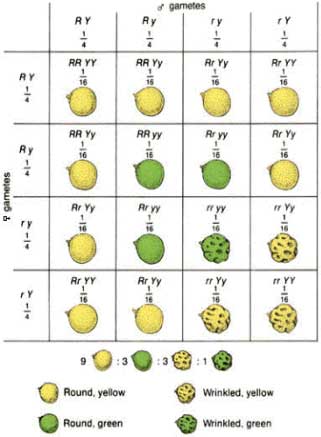
| Combination | Quantity (F2 Generation) |
|---|---|
| Round Yellow | 9 |
| Round Green | 3 |
| Wrinkled Yellow | 3 |
| Wrinkled Green | 1 |
This ratio demonstrates the Principle of Independent Assortment—traits are inherited independently.
Differences Between Monohybrid and Dihybrid Cross
| Aspect | Monohybrid | Dihybrid |
|---|---|---|
| Definition | One trait, two alleles | Two traits, each with two alleles |
| Punnett Square Size | 2×2 | 4×4 |
| Phenotypic Ratio (F2) | 3:1 | 9:3:3:1 |
| Example | Plant height | Seed shape and seed color |
| Genotypic Ratio (F2) | 1:2:1 | Variety of combinations |
Genes, Chromosomes, and Meiosis
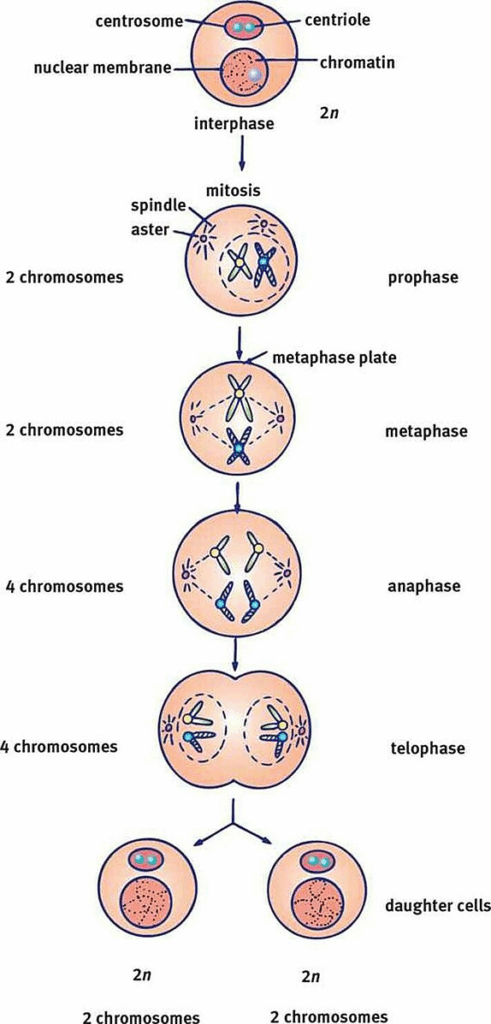
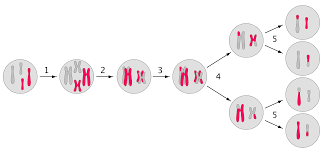
- Germ cells (sperm, egg) carry half the genetic material due to meiosis—a special cell division process.
- Meiosis ensures correct chromosome number in the offspring.
- Both male and female contribute equal genetic material—23 chromosomes each to form 46 (23 pairs).
Sex Determination in Humans
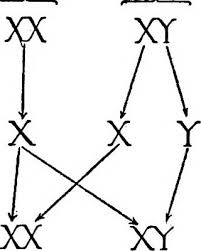
- Humans have 23 pairs of chromosomes: 22 pairs of autosomes, 1 pair of sex chromosomes.
- Females: XX
- Males: XY
- The child’s sex depends on the chromosome contributed by the father: X for girl (XX), Y for boy (XY).
- There is a 50% chance for either male or female child.
In some species, environmental factors like temperature can influence sex determination (e.g., turtles)
Conclusion
Understanding heredity and genetics is crucial for comprehending how traits are passed down and why diversity exists within species. Mendel’s experiments laid the foundation for modern genetics, emphasizing the importance of both variation and independent assortment.
Bookmark or share this blog post for your Class 10 Biology revision—master the basics and score higher in your exams!
Frequently Asked Questions on Heredity (Class 10)
Q1. What is heredity in Class 10 Science?
Heredity is the transmission of traits or characters from parents to offspring, such as eye colour, skin tone, or height.
Q2. What is variation in heredity?
Variation refers to the differences in traits among individuals. It can be somatic (not inherited) or gametic (inherited).
Q3. Why are variations important?
Variations help species survive in changing environments. For example, heat-resistant bacteria can survive better during a heat wave.
Q4. What did Mendel’s monohybrid cross prove?
It proved the Law of Dominance. Tallness is a dominant trait, with an F₂ ratio of 3 Tall : 1 Dwarf.
Q5. What did Mendel’s dihybrid cross prove?
It proved the Law of Independent Assortment, showing an F₂ ratio of 9:3:3:1 for seed shape and colour.
Q6. What is the difference between genotype and phenotype?
Genotype is the genetic constitution of an organism (TT, Tt, tt), while phenotype is the observable traits such as height or flower colour.
Q7. How is sex determined in humans?
Sex is determined by sex chromosomes. Females are XX, males are XY. The father’s chromosome (X or Y) decides whether the child will be a girl or boy.
Q8. How do Mendel’s experiments show dominant and recessive traits?
In the monohybrid cross, tallness appeared in all F₁ and 75% of F₂, proving it is dominant. Dwarfness reappeared in 25% of F₂, proving it is recessive.
Q9. If trait A exists in 10% of asexual population and trait B in 60%, which trait arose earlier?
Trait B likely arose earlier since asexual reproduction carries previous generation traits with minimal variation.
Q10. How do variations promote survival?
Variations, from sexual reproduction or DNA errors, offer different advantages such as disease resistance or climate adaptability.
Q11. Can we tell which blood group (A or O) is dominant if a daughter has group O from an A and O parent?
No. Insufficient information, as more data about siblings and genotype is needed.
Q12. How is the genetic contribution from both parents ensured?
Equal number of chromosomes is inherited from each parent—22 autosomes plus 1 sex chromosome from both.
Q13. How are traits shown as dominant or recessive?
Traits that appear in all of F1 and 75% of F2 are dominant; the hidden trait is recessive.